Jobber Pricing Explained: What It Costs in 2026
Jobber's pricing page looks simple: four plans, one slider, pick your tier. Then you notice the price you saw in the ad was the annual prepaid rate, the feature you wanted lives two tiers up, and every extra technician adds a per-user fee. None of this is unusual for field service software, but it does mean the number in your head and the number on your first invoice can be far apart.
This guide breaks down what Jobber actually costs as of August 2026, what you get at each tier, the costs people tend to miss, and an honest take on when it is worth it. All prices below are USD, pulled from Jobber's own pricing page in August 2026. Jobber changes pricing from time to time, so treat their site as the final word.
One more thing before we start: Jobber is a good product. It has been around since 2011, the mobile app is polished, and the client-facing experience is among the best in the industry. This is not a hit piece. It is the math.
Jobber Plans at a Glance (August 2026)
Jobber sells four tiers. Each includes a set number of users, and additional users cost $29 per month on every plan.
| Plan | Month-to-month | Billed annually | Users included |
|---|---|---|---|
| Core | $49/mo | $24/mo ($288/yr) | 1 |
| Connect | $139/mo | $80/mo ($960/yr) | 5 |
| Grow | $199/mo | $120/mo ($1,440/yr) | 10 |
| Plus | $499/mo | $320/mo ($3,840/yr) | 15 |
Prices as of August 2026, from getjobber.com/pricing. Additional users: $29/user/month on all plans.
There is also a middle billing option: month-to-month with a 1-year commitment, which lands between the two columns above (for example, Core at $39/mo and Grow at $169/mo as of August 2026, with a discounted first three months). Three billing modes for the same plan is why two business owners can quote you very different "Jobber prices" and both be right.
The 14-day free trial gives you full Grow plan access and does not require a credit card.
What Each Tier Actually Gets You
The plan names do not tell you much, so here is the practical version.
Core: the basics, for one person
Core covers scheduling, quoting, invoicing with online payments, basic reporting, and access to Jobber's app marketplace. At $24/mo annual it is a fair price for a solo operator who wants to look professional.
The catch is what is missing: no automated reminders, no automatic payment collection, no QuickBooks Online sync, no quote follow-ups. Those all live in Connect. Core is genuinely usable, but most of the automation that saves you admin time is one tier up.
Connect: where the automation lives
Connect adds the features most growing businesses actually buy Jobber for: automated client reminders, automatic payment collection, job forms and checklists, automated quote and invoice follow-ups, QuickBooks Online sync, and time and expense tracking. Five users are included.
At $80/mo annual for 5 users, Connect is the tier where Jobber's value story is strongest. If you compare per-seat cost against most competitors, this is competitive.
Grow: sales tools and job costing
Grow adds quote add-ons like optional line items and image-rich quotes, automatic location timers, job costing, two-way SMS, and a custom automation builder. Ten users included.
This tier is aimed at businesses that sell, not just schedule: if upselling on quotes and tracking per-job profitability matter to you, this is where Jobber starts to resemble the bigger enterprise tools.
Plus: the top shelf
Plus adds a centralized media library, team tagging in notes, profitability alerts, a dedicated onboarding specialist, and premium support, with 15 users included. At $320/mo annual ($499 month-to-month) you are in the territory where you should also be quoting Service Fusion (unlimited users) and even entry-level ServiceTitan before deciding.
The Costs People Miss
The plan price is the start, not the total. Here is what typically gets added on top.
1. Extra user seats: $29 each, every month
Every plan includes a fixed number of users, and every additional user is $29/month as of August 2026. A Connect plan with 8 users is not $80/mo annual, it is $80 + (3 × $29) = $167/mo. Seat creep is the most common reason a Jobber bill grows quietly over a year.
2. Add-ons
Three of Jobber's most-advertised capabilities are paid add-ons, not plan features, as of August 2026:
- Marketing Suite (review management, campaigns): $79/mo
- AI Receptionist (answers missed calls): $29/mo
- Pipeline (lead tracking): $49/mo
A Grow plan with all three add-ons goes from $120/mo annual to $277/mo. None of these prices are hidden, but they are easy to overlook when you compare plan cards.
3. Payment processing
Jobber Payments charges, as of August 2026: 2.9% + 30 cents per card transaction, 2.7% + 30 cents for tap-to-pay, and 1% for ACH bank payments. Instant payouts cost an extra 1%.
These rates are industry-standard, not a gotcha. But on $400,000 of annual card volume, 2.9% + fees is roughly $12,000 a year, which dwarfs the software subscription itself. If most of your clients pay by card, the processing line deserves more attention than the plan price.
4. The annual vs monthly gap
The prices Jobber advertises most prominently are annual prepaid rates. Month-to-month is roughly double on some tiers (Core: $24 vs $49). Annual prepay is a genuine discount, but it also means paying $960 to $3,840 up front and committing for the year. Budget with the column that matches how you will actually pay.
Realistic Monthly Totals by Business Size
Putting it together, here is what Jobber tends to cost in practice, using August 2026 annual rates:
| Business | Likely setup | Realistic monthly cost |
|---|---|---|
| Solo operator | Core, 1 user | $24 to $49 |
| 3-person crew | Connect, 3 of 5 seats used | $80 to $139 |
| 8-person team | Connect + 3 extra seats, 1 add-on | $195 to $280 |
| 15-person operation | Grow + 5 extra seats + add-ons | $340 to $500+ |
Payment processing fees come on top of all of these.
Is Jobber Worth It? An Honest Assessment
For established teams of 5 to 15: usually yes. Connect and Grow are priced competitively against Housecall Pro (Essentials at $149/mo annual as of August 2026) and Workiz (quote-based as of August 2026, with third-party sources reporting roughly $200 to $350/mo). Jobber's automations, QuickBooks sync, and client experience are mature and genuinely reduce admin work. If you will use what the tier includes, the money is well spent.
For solo operators and 2-3 person teams: it depends. Core is affordable but light on automation, and Connect at month-to-month rates is a real expense for a small crew. This is the segment where the per-user fees and tier gating sting most, and where free or cheaper alternatives deserve a look before you commit.
For larger operations (15+): Jobber Plus works, but you are entering the range where unlimited-user pricing (Service Fusion starts at $208/mo annual with unlimited users as of August 2026) or enterprise depth (ServiceTitan, quote-only) can make more sense. Get more than one quote.
How Jobber Compares on Price
Here is the honest side-by-side, all prices as of August 2026 from each vendor's pricing page:
| Jobber | WorkZen | Housecall Pro | |
|---|---|---|---|
| Free plan | No (14-day trial) | Yes, free forever | No (14-day trial) |
| Entry paid plan | $24/mo annual, 1 user | $59/mo annual (ZenGrow) | $59/mo annual, 1 user |
| Top standard plan | $320/mo annual, 15 users | $149/mo annual (ZenAI) | $299/mo annual |
| Extra users | $29/user/mo | Flat pricing, no per-user fees | Team plans by tier |
| AI phone answering | $29/mo add-on | AI Receptionist plans from $115/mo (500 min) | Not comparable built-in |
| Lead capture tools | Pipeline add-on $49/mo | Included: WordPress forms, landing pages, widgets | Basic |
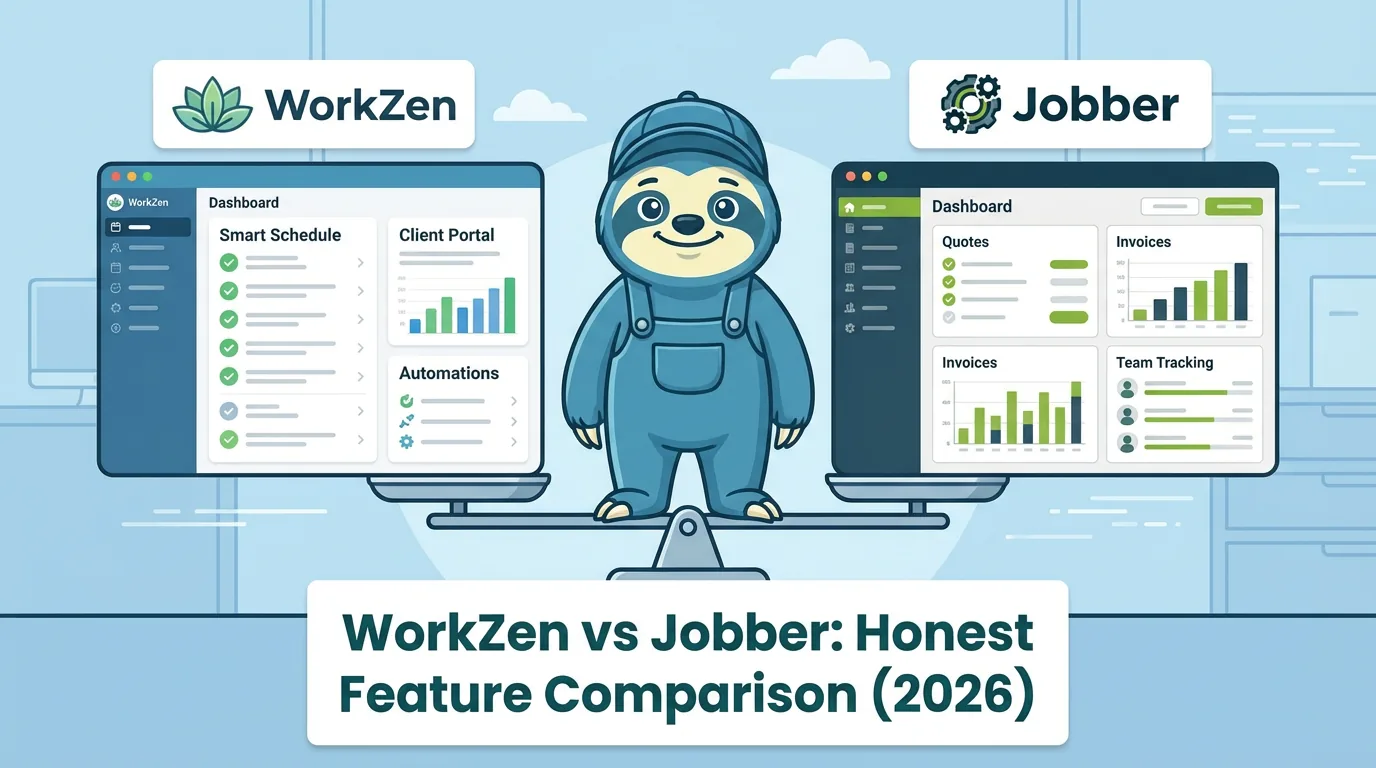
To be fair in both directions: Jobber has a larger integration ecosystem, a longer track record, and a client hub experience WorkZen does not match yet. WorkZen is the newer product. What WorkZen offers that Jobber structurally does not is a free-forever plan, flat pricing without per-seat fees, and built-in telephony and lead collection rather than add-ons.
The Bottom Line
Jobber's pricing is transparent once you know where to look: the plan card is the floor, and seats, add-ons, and card processing set the ceiling. As of August 2026 a realistic Jobber budget runs from about $24/mo for a solo operator on annual billing to $500+/mo for a mid-size team with add-ons, plus roughly 3% of card revenue in processing.
If that math works for your business, Jobber is a safe, mature choice. If you are earlier in your journey, or the per-seat model feels like a tax on growth, it is worth comparing before you commit a year up front.
We built a detailed side-by-side for exactly that: WorkZen vs Jobber comparison. And if you want to try the free-forever route first, WorkZen's free plan takes about two minutes to set up and does not ask for a credit card.
See how WorkZen compares to Jobber →
WorkZen is field service management software with a free-forever plan, flat pricing, and built-in lead collection and telephony. Start free, upgrade when the math says so.
Frequently Asked Questions
Ready to transform your field service business?
Start using WorkZen today. It's free to get started!