How to Choose Profitable Service Area Boundaries
Every service business has a story about that one job on the other side of town. The client seemed great, the job sounded profitable, so the technician drove 50 minutes to get there. By the time you factor in the round-trip drive, the fuel, the missed local jobs that could have filled that time, and the fact that the technician hit traffic coming back and was 20 minutes late to the next call - that "profitable" job barely broke even. And yet most contractors keep saying yes to these jobs because turning away work feels wrong.
Service area creep is one of the quietest margin killers in field service. It does not show up as a single dramatic loss. It shows up as a gradual erosion - slightly longer days, slightly higher fuel costs, slightly more stress on the schedule, slightly fewer jobs completed per day. Each distant job seems individually justifiable, but the cumulative effect is a business that covers a lot of ground while leaving money on the table in the neighborhoods where it should be dominant.
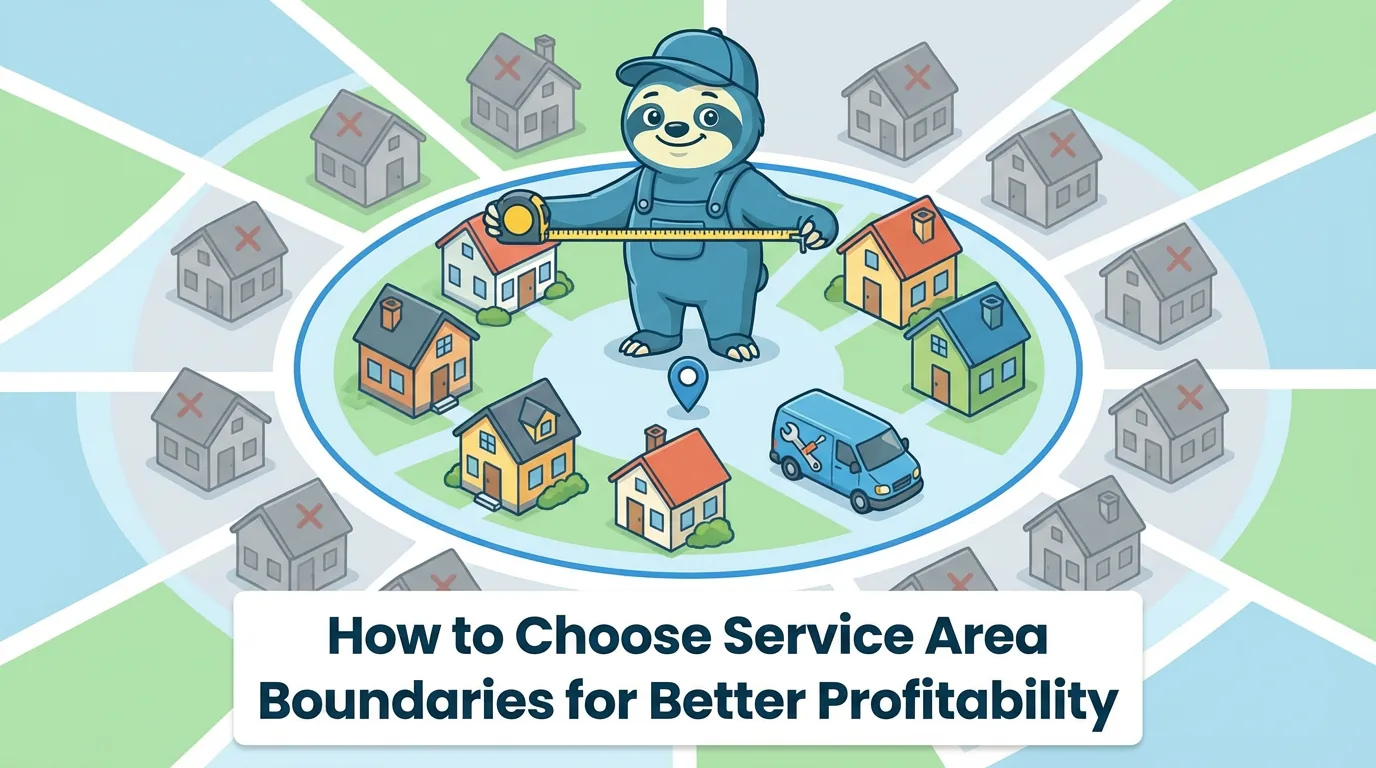
Defining clear service area boundaries is not about limiting your business. It is about concentrating your resources where they generate the highest return. The most profitable service businesses are not the ones with the widest reach. They are the ones with the densest schedules in a focused geographic zone. 🗺️
The Hidden Cost of Drive Time
Drive time is the most expensive non-billable activity in a field service operation. When your technician is behind the wheel, they are not generating revenue, but they are generating cost. Labor, fuel, vehicle depreciation, and insurance are all running whether the truck is parked at a job site or stuck in traffic on the highway.
Consider a simple example. Your technician earns $40 per hour fully loaded (wages, benefits, workers comp). A job 40 minutes from your core area means 80 minutes of round-trip drive time - that is roughly $53 in labor just for the drive. Add $15 to $25 in fuel and vehicle costs depending on your market, and you are spending $70 to $80 before the tech even touches a wrench. If that job bills at $300, your effective margin just dropped by 25 percent compared to a local job with a 10-minute drive.
| Scenario | Drive Time (round trip) | Labor Cost | Fuel + Vehicle | Total Pre-Job Cost | Effective Margin Loss |
|---|---|---|---|---|---|
| Local job (10 min away) | 20 min | ~$13 | $5 | ~$18 | Minimal |
| Edge job (40 min away) | 80 min | ~$53 | $15 - $25 | ~$70 - $78 | ~25% |
| Distant job (60 min away) | 120 min | ~$80 | $25 - $40 | ~$105 - $120 | ~35 - 40% |
The opportunity cost is even larger. Those 80 minutes of drive time could have been spent completing another local job. If your average job bills $250 and takes 90 minutes including a short local drive, every long-distance trip costs you roughly one additional job worth of revenue. That is the math most contractors never run - not just what the distant job costs, but what the local job you did not do would have earned. 💡
Using Job History to Find Your Profitable Zones
Your own data will tell you where your money is. Pull the addresses from your last six to twelve months of completed jobs and look at the geographic distribution. Most service businesses discover that 70 to 80 percent of their revenue comes from a surprisingly compact area - usually a 20 to 30 minute radius from their shop or the center of their operation.
The jobs outside that core zone often have lower margins even when the ticket price looks similar. Longer drives mean fewer jobs per day, which means higher overhead per job. The scheduler has to leave wider gaps between appointments to account for variable drive times, which creates dead slots that are hard to fill. A technician who completes five local jobs in a day is almost always more profitable than one who completes three jobs scattered across a wide area, even if the individual ticket values are comparable.
Plot your jobs on a map and color-code them by profitability - not just revenue, but revenue minus drive cost. The pattern will be obvious. Your most profitable work clusters tightly, and your least profitable work is at the edges. That visual is the starting point for defining boundaries that protect your margins instead of diluting them. 📊
When to Contract Your Service Area
Contracting your service area sounds counterintuitive when you are trying to grow, but it is often the fastest path to higher profitability. If your schedule is busy but your margins are thin, the problem is usually geographic spread. You are running a wide route with too much windshield time and not enough wrench time.
The signal that you need to tighten is when your technicians consistently finish the day later than planned, not because jobs ran long, but because drives took longer than expected. Another signal is when your fuel costs per job are climbing even though fuel prices are stable - that means your average drive distance is increasing. A third signal is when your on-time arrival rate is dropping because distant jobs create cascading delays across the day.
Contracting does not mean refusing all work outside your core area. It means being deliberate about which distant jobs you accept and pricing them to reflect the real cost of service. The jobs inside your core zone get standard pricing and priority scheduling. The jobs outside get a trip charge, a higher minimum, or a longer lead time. That differential naturally concentrates your schedule where it is most efficient without requiring you to turn away every out-of-area request.
When to Expand Your Service Area
Expansion makes sense when you have saturated demand in your current zone and have the crew capacity to serve a wider area without degrading quality for existing clients. The key indicators are a schedule that is consistently booked two to three weeks out, a growing waitlist of clients you cannot serve promptly, and enough technicians to split routes by zone.
Expand into adjacent areas first, not distant ones. If your core zone is a 25-minute radius, expand to 35 minutes - not to a town 60 minutes away that looks promising on paper. Adjacent expansion preserves route density because technicians can still swing between the old zone and the new one within the same day. Leapfrog expansion, where you serve a distant area with no jobs in between, creates the worst possible scheduling dynamics.
Track the new zone's profitability separately for the first three months. Measure revenue per job, jobs per day, on-time rates, and fuel costs in the expansion area compared to your core zone. If the new zone underperforms significantly after a fair trial period, tighten back. Expansion should be a data-driven experiment, not an emotional commitment to covering more territory. 📈
How to Say No to Out-of-Area Requests
Declining work feels uncomfortable for most contractors, especially when the phone is ringing and someone wants to give you money. But saying yes to every request regardless of geography is how service areas creep in the first place. Having a professional, consistent way to handle out-of-area requests protects your schedule and your reputation.
The simplest approach is honest and helpful. "We focus our service area within [zone] to keep our response times fast and our pricing competitive. For your area, I would recommend reaching out to [partner company] - they do excellent work." That response is polite, explains the reason behind the boundary, and offers an alternative so the caller does not feel dismissed.
If you have referral partnerships with contractors in adjacent areas, out-of-area requests become referral opportunities rather than lost leads. You maintain a professional reputation, your partner gets a warm lead, and the client gets connected to someone who can serve them well. Over time, some of those partners will refer work back to you from their area, creating a reciprocal flow that benefits everyone.
Zone-Based Pricing for Edge Areas
Not every job outside your core zone needs to be refused. Some are worth taking if the pricing reflects the real cost of service. Zone-based pricing creates a transparent framework where clients in your primary area pay standard rates and clients in outer zones pay a trip charge or a higher service minimum.
Define two or three zones based on drive time from your shop or the center of your operation. Zone A is your core - no trip charge, fastest response times, priority scheduling. Zone B is your secondary area - a $30 to $50 trip charge applies, and scheduling may take an additional day or two. Zone C is your outer boundary - trip charges are higher, minimum job values apply, and you only schedule these when they can be grouped with other jobs in the area.
| Zone | Drive Time | Trip Charge | Response Time | Scheduling Priority |
|---|---|---|---|---|
| Zone A - Core | 0 - 25 min | None | Same day / next day | Highest |
| Zone B - Secondary | 25 - 40 min | $30 - $50 | 1 - 2 days | Standard |
| Zone C - Outer | 40 - 60 min | $60 - $100+ | 3 - 5 days (grouped) | Low |
Communicate the zones clearly on your website and during booking. Most clients understand that distance costs money, just as they understand that delivery fees exist for online orders. A transparent trip charge is far better received than a vague "we will have to see" or a surprise surcharge on the invoice. Clients in edge areas who accept the pricing are self-selecting as serious buyers, which improves your close rate on those distant jobs. ✅
Density-Based Scheduling Benefits
The real power of a focused service area is density - the ability to stack multiple jobs close together in a single day. When your jobs are clustered within a tight zone, your technician spends less time driving between appointments and more time working. Five jobs within a 15-minute radius produce more revenue and less stress than three jobs scattered across a 45-minute span.
Dense scheduling also improves your ability to handle emergencies and same-day requests. When your technician finishes a job in the core zone and has a 30-minute gap, a nearby emergency call becomes easy to accommodate. When the same gap exists but the technician is 40 minutes from the core zone, that flexibility disappears. Density creates operational slack that makes your business more responsive without adding staff.
Route optimization tools can help, but they only work well when the underlying job distribution supports efficient routing. No algorithm can create a good route from jobs that are geographically scattered. The best route optimization starts with a focused service area that gives the software a cluster of nearby jobs to work with rather than a scattered mess of pins across the map.
Seasonal Service Area Adjustments
Your ideal service area is not static. During peak season, when local demand fills your schedule easily, there is no reason to drive 40 minutes for a job you could replace with a closer one. Tightening your area during busy months maximizes your jobs-per-day rate and keeps your team from burning out on long drives during the most demanding period of the year.
During slower months, a modest expansion can help fill the schedule. Jobs that would not be worth the drive in July might make sense in January when the alternative is an empty slot. The key is treating the expansion as temporary and intentional, not as a permanent boundary shift. Set a calendar reminder to re-evaluate when peak season approaches.
| Season | Recommended Area | Strategy | Goal |
|---|---|---|---|
| Peak season | Core zone only | Tighten boundaries, surcharge distant jobs | Maximize jobs per day |
| Shoulder season | Core + Zone B | Accept standard edge work | Maintain throughput |
| Slow season | Core + Zone B + selective Zone C | Fill gaps with distant jobs, test new zones | Keep technicians productive |
This flexibility lets you match your geographic footprint to your actual capacity, which is the fundamental principle behind service area management. Your boundaries should serve your business strategy, not the other way around.
Frequently Asked Questions
Ready to transform your field service business?
Start using WorkZen today. It's free to get started!