GEO for Contractors: How to Show Up in AI Search Results
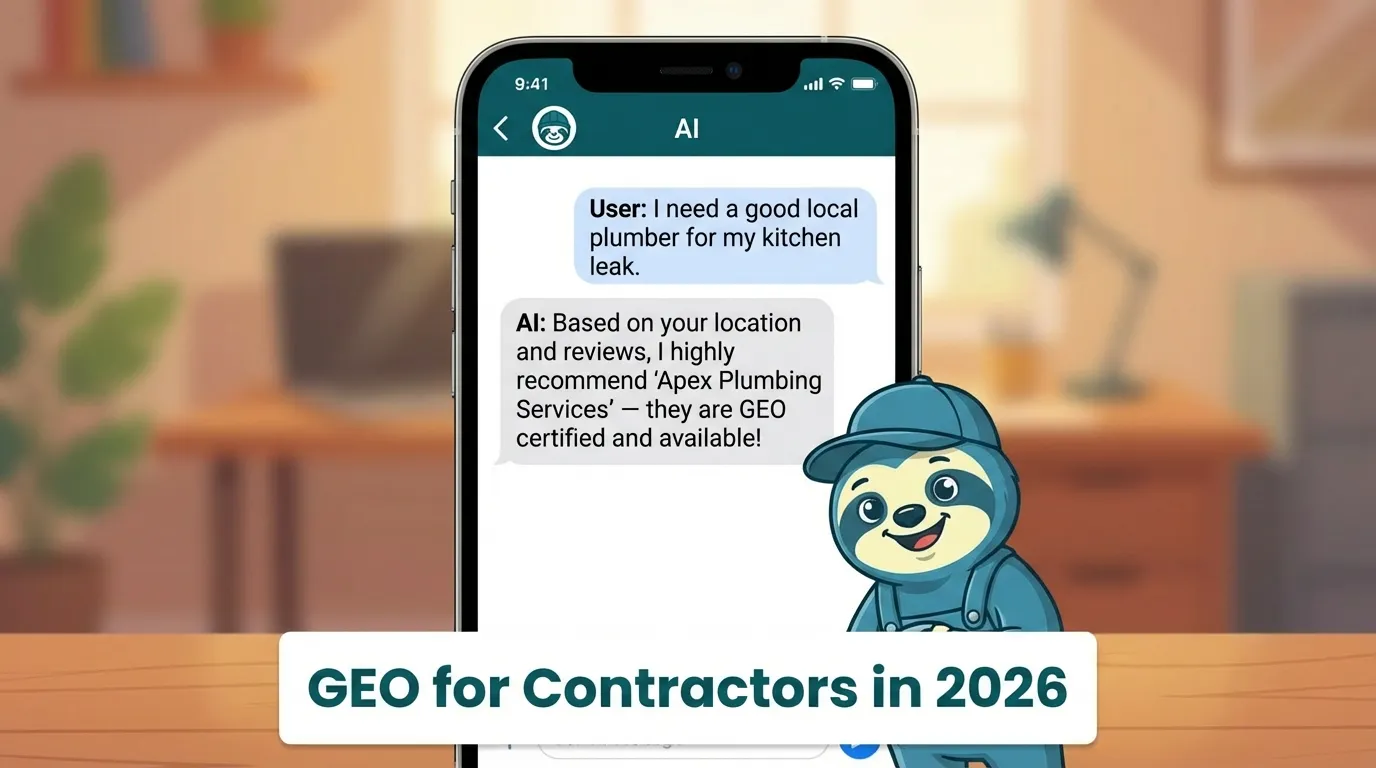
We recently wrote about SEO for contractors - how to show up when clients Google "plumber near me" or "HVAC repair in Dallas."
But here's the thing: your clients aren't just Googling anymore.
They're asking ChatGPT. They're searching on Perplexity. They're reading Google's AI Overview at the top of search results. And when they ask "who's the best electrician in Phoenix?" - AI gives them a direct answer. Not a list of ten blue links. A recommendation.
If that recommendation isn't you, you've got a problem.
Welcome to GEO - Generative Engine Optimization. It's the next chapter of getting found online, and contractors who figure it out early will have a massive advantage.
What Is GEO and Why Should Contractors Care?
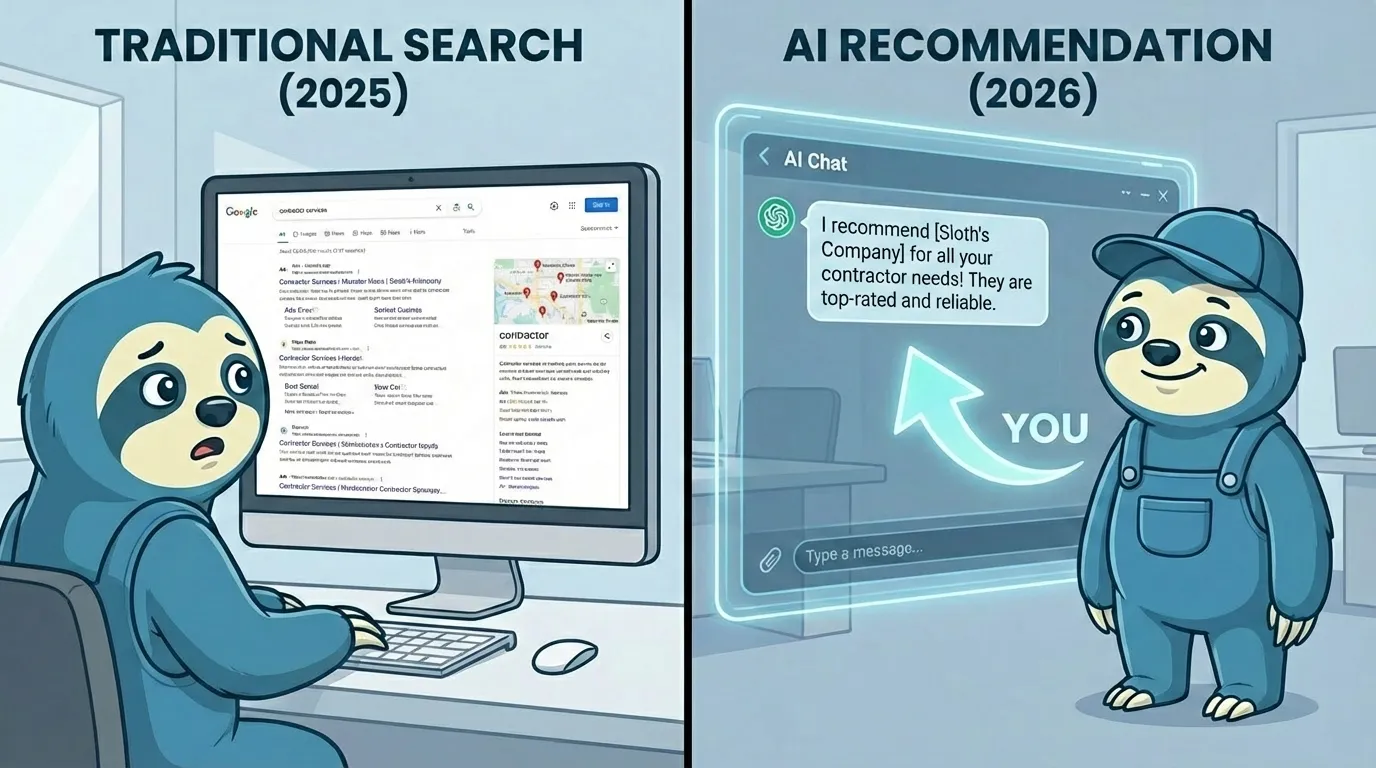
GEO stands for Generative Engine Optimization. If SEO is about ranking on Google's search results, GEO is about getting recommended by AI-powered tools.
Here's the shift that's happening:
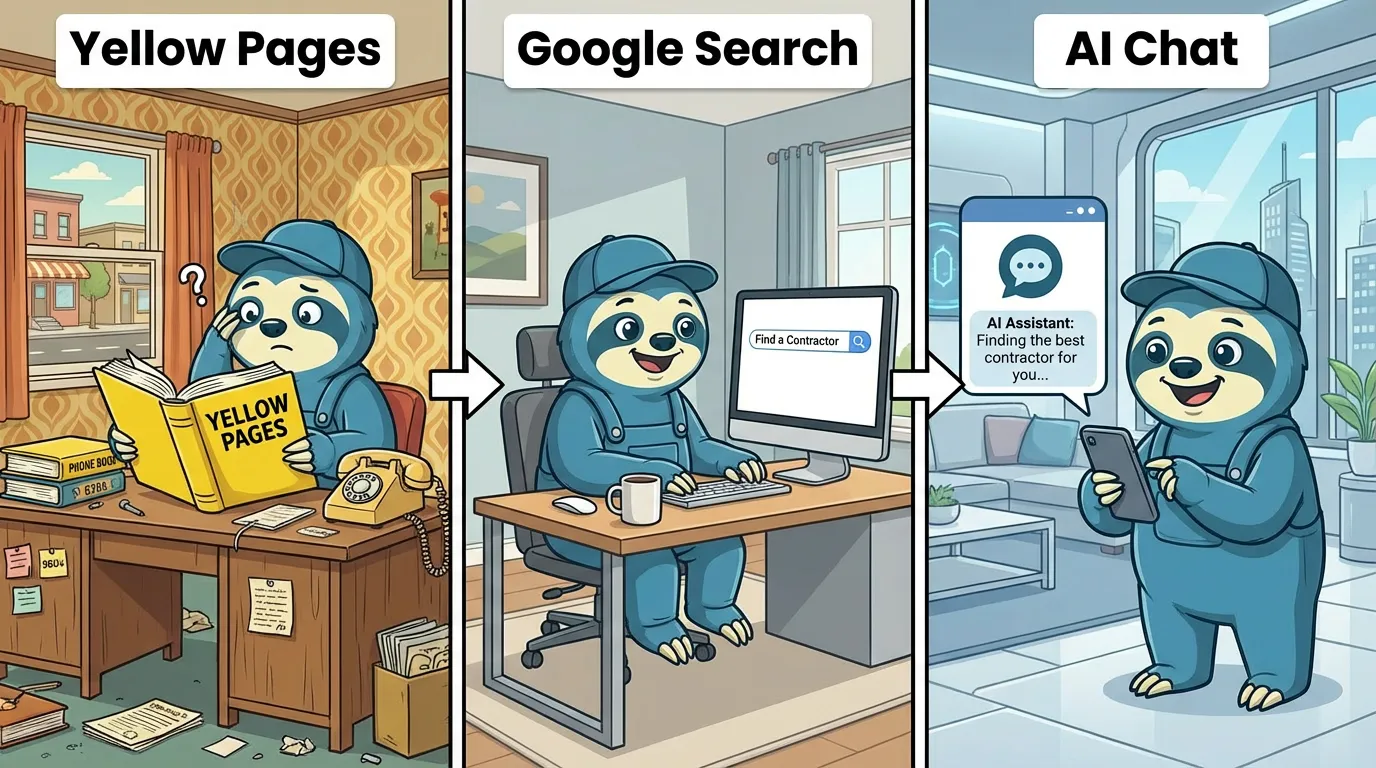
The old way (SEO):
- Client searches "AC repair near me"
- Google shows 10 results
- Client clicks through a few, compares, calls someone
The new way (GEO):
- Client asks AI "who should I call for AC repair in my area?"
- AI recommends 2-3 specific businesses with reasons
- Client calls the top recommendation directly
See the difference? In the old model, you competed for attention among 10 results. In the new model, AI does the filtering and hands the client a short list. If you're on it, you win. If you're not, you don't even get a chance.
The numbers are real:
- Over 100 million people use ChatGPT weekly
- Google AI Overviews appear on 40%+ of searches
- Perplexity processes millions of search queries daily
- 30%+ of Gen Z and millennials have used AI to find local services
This isn't future speculation. It's happening right now. And it's accelerating.
How AI Search Actually Works (No Tech Degree Required)
To optimize for AI, it helps to understand how these tools decide what to recommend. It's actually simpler than traditional SEO algorithms.
AI models pull from three main sources:
1. Your existing web presence
Everything that's already online about your business - your website, Google Business Profile, directory listings, social media. AI crawls all of it. The more detailed and consistent your information, the more confidently AI can recommend you.
2. What other people say about you
Reviews are massive here. AI models heavily weight what real clients say. A contractor with 200 detailed Google reviews has a huge GEO advantage over one with 15. But it's not just reviews - mentions on forums, local news, community sites, and industry directories all feed into AI's understanding of your reputation.
3. How well you answer the question being asked
When someone asks "what should I expect to pay for a water heater installation in Denver?" - AI looks for content that directly answers that question. If your website has a detailed FAQ or blog post covering water heater installation pricing in Denver, you become a source AI can cite and recommend.
The key insight: AI doesn't rank websites. It synthesizes information from everywhere and builds a picture of which businesses are trustworthy, relevant, and well-regarded. Your job is to make sure that picture is accurate and strong.
GEO vs SEO: What's Different?
If you've already invested in SEO (and you should - here's our complete guide), you're ahead of the game. Good SEO creates a strong foundation for GEO. But there are important differences.
Where they overlap:
- Google Business Profile optimization (critical for both)
- Review quantity and quality (critical for both)
- Website content quality
- NAP consistency across directories
- Mobile-friendly, fast-loading website
Where GEO goes further:
| SEO Focus | GEO Focus |
|---|---|
| Keywords in titles and headers | Natural language content that answers questions |
| Backlinks from other sites | Mentions and citations across diverse sources |
| Ranking position on page 1 | Being the business AI chooses to recommend |
| Optimizing for Google's algorithm | Optimizing for how AI models understand trust |
| Click-through rate from search results | Being cited as the answer, not just a result |
The biggest difference: SEO optimizes for algorithms. GEO optimizes for trust and authority across the entire internet. AI models don't care about meta tags or keyword density - they care about whether your business appears trustworthy, well-reviewed, and relevant based on everything they can find about you.
The 7 GEO Strategies for Contractors
Here's the practical stuff. What you can actually do to start showing up in AI recommendations.
Strategy #1: Build a Review Fortress
This is the single most impactful thing you can do for GEO. AI models treat reviews as the strongest signal of business quality.
What matters for GEO reviews:
- Volume: More reviews = more data for AI to assess you
- Recency: Reviews from the last 3 months matter more than reviews from 3 years ago
- Detail: "Great service" is okay. "John arrived on time, diagnosed our AC issue quickly, explained the repair options clearly, and had it fixed in under an hour. Fair pricing too." is gold for AI
- Responses: Your replies to reviews show AI you're an engaged, responsive business
- Diversity: Reviews on Google, Yelp, Facebook, and industry sites create a broader signal
Action: Don't just ask for reviews - ask for detailed reviews. "Would you mind mentioning what work we did and how the experience was?" gives AI more context to work with.
Strategy #2: Create FAQ Content That AI Can Reference
When someone asks ChatGPT "how much does it cost to replace a furnace in Chicago?" - AI needs a source to pull from. If your website has a detailed, honest answer to that exact question, you become that source.
High-value FAQ topics for contractors:
- "How much does [service] cost in [your city]?"
- "How long does [service] take?"
- "What should I look for when hiring a [trade]?"
- "How often should I [maintenance task]?"
- "What's the difference between [option A] and [option B]?"
- "Is [common concern] dangerous?"
- "When should I repair vs replace my [equipment]?"
How to structure FAQ content for GEO:
- Use the actual question as the heading
- Give a direct, honest answer in the first sentence
- Follow with detail and context
- Include specific numbers (price ranges, timeframes)
- Mention your city/service area naturally
- Don't make it salesy - make it genuinely helpful
AI models prioritize content that's helpful and authoritative over content that's promotional. The contractor who writes honest, detailed answers gets cited. The one who writes "call us for a free quote!" doesn't.
Strategy #3: Get Mentioned Beyond Your Own Website
AI models build trust by looking at how many independent sources mention your business. Your own website saying "we're the best" means nothing. Other people and platforms saying it means everything.
Where to build mentions:
- Local news and blogs: Sponsor a community event and get covered
- Industry forums: Answer questions on Reddit, trade forums, community boards
- Social media: Active presence where people talk about local services (Nextdoor, local Facebook groups)
- Partnerships: Get mentioned on partner websites (suppliers, complementary trades)
- Local directories: Beyond the basics - neighborhood associations, local business groups
- PR: A quote in a local article about home maintenance or energy efficiency carries weight
The "digital footprint" concept: AI's confidence in recommending you is directly proportional to how many credible, independent sources confirm you exist and do good work.
Strategy #4: Add Structured Data to Your Website
Structured data (also called Schema markup) is code that helps AI models understand your business information precisely. It's like filling out a form that AI can read directly.
The structured data that matters for contractors:
- LocalBusiness schema: Your name, address, phone, hours, service area
- Service schema: Each service you offer with descriptions
- Review schema: Aggregate rating display
- FAQ schema: Your FAQ content in a machine-readable format
- HowTo schema: For how-to content on your site
If this sounds technical - it is, slightly. But most website builders have plugins that handle it. For WordPress, a plugin like Yoast or Rank Math adds structured data automatically. If you hire a web developer, ask them to implement local business schema.
Why it matters: Structured data removes ambiguity. Instead of AI guessing that "Bob's Plumbing" at "123 Main St" is a plumbing business in Dallas, your structured data tells it explicitly. Less guessing = more confident recommendations.
Strategy #5: Write Content Like a Human Expert, Not a Marketing Department
AI models are trained on billions of pages of content. They can tell the difference between generic marketing copy and genuine expertise. The more your content sounds like a real contractor sharing real knowledge, the more AI trusts and cites it.
Content that AI loves to reference:
- Specific cost breakdowns with real numbers
- "In my experience" insights that only a practitioner would know
- Honest pros and cons (not everything-is-amazing marketing speak)
- Local knowledge (mentioning specific neighborhoods, local building codes, regional climate considerations)
- Real job examples (with client permission)
Content that AI ignores:
- Vague, generic descriptions
- Keyword-stuffed pages
- Content that reads like every other contractor's website
- Pure sales pages with no educational value
Think about it this way: if someone asked you at a barbecue "how do I know if my AC is dying?" - whatever you'd naturally say is probably better GEO content than whatever a marketing agency would write.
Strategy #6: Be Consistent Everywhere
AI cross-references information about your business across dozens of sources. Inconsistencies create doubt. If your website says you serve 12 cities but your Google profile lists 8, or your hours are different on Yelp than on Google, AI trusts you less.
The consistency checklist:
- Business name spelled exactly the same everywhere
- Phone number in the same format everywhere
- Address matches across all platforms
- Hours of operation are current and consistent
- Service list is complete and matches across platforms
- Service area is consistent
- Pricing (if listed) is consistent
Pro tip: Set a calendar reminder to audit your listings quarterly. Things drift over time - someone updates one platform and forgets the others.
Strategy #7: Monitor What AI Says About You
This is the simplest strategy and most contractors don't do it. Just ask AI about yourself.
Try these searches regularly:
In ChatGPT, Perplexity, and Google AI Overviews:
- "Best [your trade] in [your city]"
- "Who should I call for [your main service] in [your area]?"
- "Recommended [your trade] near [your location]"
- "[Your business name] reviews"
What to look for:
- Are you mentioned at all?
- Is the information accurate?
- What competitors are being recommended?
- What are competitors doing that you're not?
If you're not appearing, that's your baseline. Now you know where you stand and can track progress as you implement these strategies.
The GEO Action Plan: What to Do This Month
Week 1: Audit your AI presence
- Search for your business and services in ChatGPT
- Search in Perplexity
- Check Google AI Overviews for your key services
- Document what appears (screenshot it)
Week 2: Strengthen your review game
- Ask 5 recent clients for detailed reviews
- Respond to all existing reviews (every single one)
- Set up a system to ask after every completed job
Week 3: Create FAQ content
- Write answers to 10 questions clients ask most
- Publish them on your website (FAQ page or individual blog posts)
- Include real numbers, local details, and honest insights
Week 4: Expand your digital footprint
- Verify and update all directory listings
- Ensure consistency across every platform
- Identify 3 places to get mentioned (community groups, local blogs, partner sites)
SEO + GEO: The Complete Strategy
Here's the honest truth: you don't need to choose between SEO and GEO. They reinforce each other.
Good SEO practices build the foundation that GEO needs. Strong reviews improve both your Google rankings and your AI recommendations. Quality content helps you rank in traditional search and get cited by AI.
Think of it this way:
- SEO makes sure you show up when people search Google
- GEO makes sure you get recommended when people ask AI
- Together they make sure clients find you no matter how they search
The contractors who win in 2026 and beyond aren't choosing one or the other. They're building an online presence so strong that every search tool - traditional and AI - recognizes them as the obvious choice.
The Window Is Open (For Now)
Right now, most contractors have never heard of GEO. They're not thinking about AI search. They're not optimizing for it.
That's your advantage.
The contractors who start building their GEO presence today will be the established, trusted recommendations by the time their competitors realize what happened. Just like early adopters of Google Business Profile had a head start that took others years to catch up to.
The search landscape is shifting. Your clients are already using AI to find services. The only question is whether they're finding you - or someone else.
Managing leads from traditional search AND AI recommendations means more calls to track and convert. WorkZen helps contractors capture every lead from every source, so no opportunity slips through the cracks. See how it works.
Frequently Asked Questions
Ready to transform your field service business?
Start using WorkZen today - it's free to get started!